Upernavik
Smilla's Sense of SnowUpernavik is a Greenlandic town that appears in Smilla’s recollections as a destination shaped by economic centralization and as the place where her brother’s life ended. It connects the closure of a remote trading post to a personal loss, while also marking the wider distances and dislocations in her family’s history.
Setting and Context
The novel places Upernavik within a changing Greenlandic economy. When the Greenland Trading Company closed its business on Maxwell Island in 1979, Smilla’s brother, who had hunted there for ten years, was driven south to Upernavik. The transition took him from a life of hunting on the island to work sweeping the harbor docks when Smilla was posted at a meteorological station.
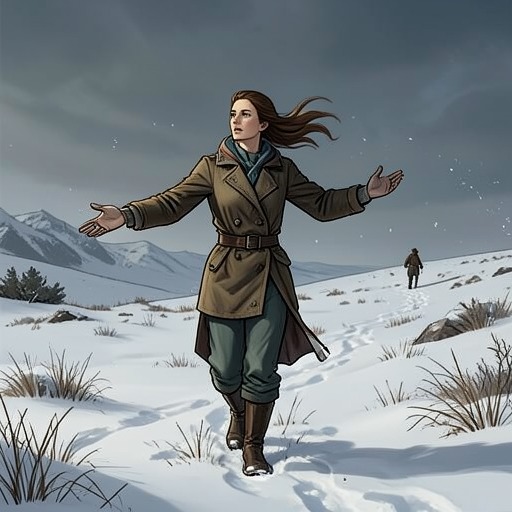
Upernavik also figures in Smilla’s account of childhood flight. Between the ages of seven and thirteen, she ran away repeatedly after coming to Denmark; twice she made it to Greenland, and once as far as Thule. Her recollection describes children attaching themselves to families and pretending a parent is nearby, placing Upernavik within a broader geography of attempted escape and return.
Family History and Loss
A report summarizing the Jaspersen family’s circumstances records that Smilla’s brother died by suicide in Upernavik in September 1981. In her own retrospective account, Smilla links his death to the displacement that followed Maxwell Island’s store closure: after ten years as a hunter there, he moved south, and the following year he took his life.
The town’s significance is therefore both local and familial. It is where the consequences of economic change become inseparable from the history of Smilla’s family, and where her brother’s movement away from the island ends in a death that the official report records tersely.
Centralization and Its Consequences
Smilla sets her brother’s move against the Greenland Trading Company’s centralizing program, which closed its business on Maxwell Island in 1979. She observes that officials acknowledged the difficulty of combining centralization with the hunting trade but did not state that further suicides would follow, even though that consequence was understood. Her brother’s relocation to Upernavik gives this political and economic change an individual cost.
The town thus belongs to a network of places through which the book traces changes in Greenlandic life: the island where her brother had been a hunter, Upernavik where he found dock work, and the broader movement south toward more centralized settlement and administration. Upernavik is not merely a point on that route; it is the place where an abstract policy of reorganization becomes part of a family’s lasting grief.